Rebuilding
the Chevrolet LT1 Engine
Thirty-seven years after the birth of the small block
Chevy V8, the Generation II engine was introduced in the 1992 Corvette
as the LT1. Doug Anderson breaks down the options.
By Doug Anderson
Source:
http://www.enginebuildermag.com/Article/2562/rebuilding_the_chevrolet_lt1_engine.aspx?page=1
Although it shared many common dimensions,
looked much the same and even had a few common parts, it was totally
redesigned to provide more power with lower emissions and better fuel
economy.
Compared to the 1991 Chevy 350 L98 with TPI,
the LT1 made 20% more horsepower, got better fuel mileage, and had a
much broader torque band with 90% of it’s peak torque available from
just over 1,000 rpm all the way up to nearly 6,000 rpm.
GM Powertrain accomplished all of this by
reverse cooling the engine so they could bump the compression ratio up
to 10.5 to 1, tweaking the airflow in and out of the engine, and using
sophisticated electronic controls for both fuel and ignition. This
combination gave the LT1 300 hp in 1992 and ultimately led to the 1996
LT4 that used better heads, more cam timing, roller rockers and
sequential fuel injection to make 330 hp .
Although the LT1 was only around for five
years, there were two-bolt and four-bolt blocks, aluminum and cast
iron heads, regular and H.O. cams that came with long and short
dowels, and three different front covers. There was also the "Baby
LT1," the 265 cid version that was the standard engine in the Caprice
from 1994-‘96. With all that in mind, let’s take a look at this family
of engines and see what goes where.
BLOCKS
350 - There are two blocks, one with two-bolt mains and one
with four-bolt mains. They both have the same 10125327 casting number,
so there’s no sure way to know which one you have until you get the
pan off. However, if it came out of a Corvette, it should be a
four-bolt block, and if it came out of anything else, it was supposed
to be a two-bolt. GM used the two-bolt block for everything but the
Corvette because it had plenty of strength and it weighed a little bit
less.
265 - There was only one block used for the
265 cid version of the LT1. It’s a 10168588 casting that had the
numbers "4.3" cast on the side, too. It’s real easy to spot if the
heads are off because of the small 3.74" bore.
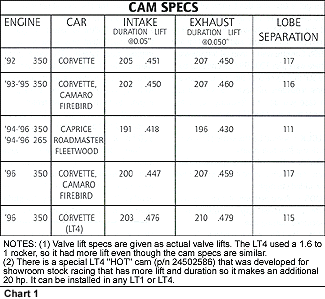
Getting the right cam in the right engine can be
a little bit tricky because there were several variations over the
years. There are essentially two different grinds used with two
different snouts, depending on which distributor was used on the
engine.
CRANKS
350 - The crank for the LT1 looks just like the one in the late 350
and has the same casting number 14088526, but it’s balanced for the
lightweight pistons that were installed in the LT1. Be sure to keep
these cranks separate so they don’t end up in a regular 350, and don’t
ever use a regular 350 crank in a LT1. In fact, if you are short of
LT1 cranks and don’t have a balancing machine in your shop, you would
be better off using a crank from a 305 instead of a 350 because it’s
actually closer to the balance specs for the LT1 crank.
265 - The 265 has it’s own unique crank with
a 3.00" stroke. That’s the same stroke the original 265 had back in
1955; it’s funny how things go around and come back full circle. It’s
a 10168568 casting.
RODS
350 - The original LT1 came with regular forged 350 rods,
that were shot peened for localized hardness under the head of the
bolt and nut. Powdered metal rods were phased in for the Corvette
around 1994 and used in all of the LT1 engines by 1995. GM made the
change because the powdered metal rods were cheaper to make and were
much stronger than the GM high performance "pink" rods. In fact, they
are supposed to be good for up to 450 hp. They are machined at the
parting line so they can be reconditioned.
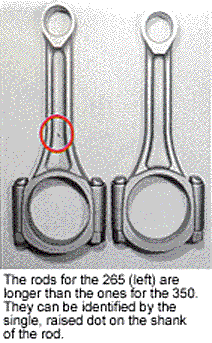
265 - The 265 rods are 0.240" longer than the
ones in the 350. Both blocks are the same height, but the stroke for
the 265 is 0.480" shorter, so the rods have to be longer to make up
for half the difference. These rods can be identified by the single,
raised dot on both sides of the shank.
CAMS
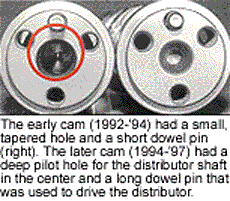
1992-’95 350 WITH ALUMINUM HEADS - The 1992 Corvette
had a steel roller cam with a shallow hole in the snout that measured
.450" in the front and tapered down to .240" at the bottom. It had a
short dowel (.320") that was used to locate the timing gear and a hole
with 16 splines in the center of the gear for the stub shaft that
drove the early distributor. The 1993-‘94 H.O. cam had a few subtle
changes, but all of the early H.O. cams are the same for all intents
and purposes. They can be identified by the number "241" stamped on
the barrel in front of the first lobe.
1994-’96 350 WITH IRON HEADS
- The distributor drive was changed on the iron-headed motors only in
1994, so the front of the cam and the timing gear were changed, too.
The cam had a pilot hole that was bigger and deeper (0.500" x 1.0625")
and it had a longer (.685") dowel pin that stuck out beyond the timing
gear to drive the new distributor. This iron-headed motor was used in
the Chevy Caprice, Buick Roadmaster and Cadillac Fleetwood, so it came
with a milder cam that improved low end torque and reduced valve train
noise. These cams have the long dowel pin and either "600" or "779"
stamped on the barrel of the cam in front of the first lobe.
1995-’97 350 WITH ALUMINUM HEADS
- In 1995, the aluminum-headed motors got the late, pin-drive
distributor, so there’s a second version of the H.O. cam with the big
pilot hole (.500" x 1.0625" ) and the long (.685" ) dowel pin. Look
for a cam with the long pin and either "242" or "705" stamped on the
barrel in front of the first lobe.
1994-’96 265-INCH MOTORS -
All of the 265 engines came with the later, pin-drive distributor, so
they all had the later style cam with the big pilot hole and the long
dowel pin. The 265 used the same mild cam that came in the iron-headed
LT1. Look for the long dowel pin and either "600" or "779" stamped on
the barrel of the cam in front of the first lobe.
CAM GEARS
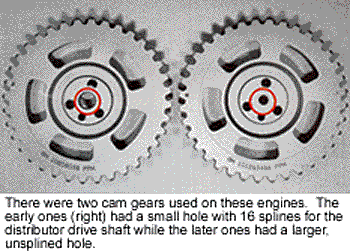
The cam gear had to match the cam and the distributor drive,
so there were two different gears used, depending on the year and the
application.
The original cam had a small, tapered hole in
the center and a short dowel pin. It was used with the cam gear that
had the small hole in the center with 16 splines in it. It was
connected to the distributor with a short drive shaft that was splined
on both ends. The cam gear is a GM p/n 10128349. This combination was
used from 1992-‘95 on the aluminum-headed motors.
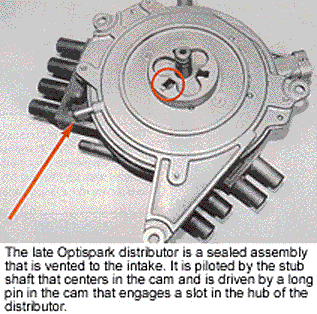
GM had some problems with the early
distributor due to both carbon tracking and moisture, so a new sealed
distributor with a vacuum port was introduced on the iron-headed 265s
and 350s in 1994 and used on all LT1s in 1995. The new distributor was
located with a pilot shaft and driven by a pin, so both the cam and
the gear were changed. The cam had a large, deep hole in the center
for the pilot shaft and a longer dowel pin to drive the distributor.
The cam gear had a bigger hole and it didn’t
have the splines that were found in the early gear. The pilot shaft
for the distributor extends through the hole in the cam gear and seats
in the hole in the cam; the distributor is driven by the long dowel
pin that sticks up through the cam gear. The cam gear is a GM p/n
10206039.
350 ALUMINUM HEADS - There
were two versions of the aluminum heads used on the Corvettes, Camaros
and Firebirds. The later ones have less material around the top of the
intake ports and weigh about 2- 1/2 lbs. less than the earlier ones,
but they are identical otherwise. Look for a 10128374 and possibly a
649.
FRONT COVERS
The front covers have been changed three times, once because
of the changes that were made to the distributor and once due to OBD
II.
The original cover had three holes, one for
the crank, a small hole (@ 0.70") for the water pump drive and a
second one for the small drive shaft for the distributor. It’s a
10128289 casting.
The second front cover still had the small
hole for the water pump shaft, but it had a much larger hole (@ 2.63")
that sealed on the outside of the distributor housing itself. It’s a
10214196 casting.
The second cover was modified again in 1996
to accommodate the crank position sensor that was located in the lower
corner of the cover on the passenger side. This same cover was used
for the few engines that were installed in 1997, too. It’s a 12550032
casting.
HEADS
There were two heads used on the 350, one aluminum and one cast iron,
along with one cast iron head for the 265. GM claimed that the
original LT1 aluminum head had a 15% increase in airflow as a result
of revised port angles and higher port ceilings when compared to the
1991 L98 head. That was impressive in 1992, but the iron LT1 head that
came out in 1994 was even better. It flowed 20% more on the intake
side and made more horsepower on the dyno.
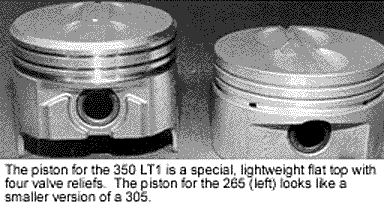
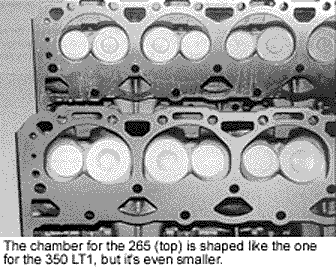
All LT1 heads used small combustion chambers
to get the higher compression ratios with flat top pistons; the 350s
had a 10.5 to 1ratio and the 265s had a 9.8 to 1 ratio.
350 IRON HEADS - All of the
full-size cars came with iron heads. They were 10125320 or 12554290
castings.
265 IRON HEADS - The 265 had
its own unique cast iron head with a 10208890 casting number. The
chambers are smaller, so these heads cannot be interchanged with any
of the 350 LT1 heads.
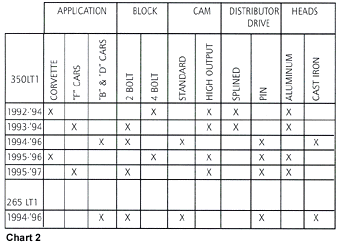
That’s the story on the parts and pieces for
the LT1. Chart 2 on page 35 shows how they all fit together year by
year, but there are a few more things every rebuilder should know in
order to avoid some possible problems.
HEAD GASKETS
The 350 LT1 head gaskets are not interchangeable with regular
350 Chevy head gaskets because they have different water passages due
to the reverse cooling. The original head gaskets on the LT1 were
wider and had holes that held the pushrods in place for assembly, but
the replacement gaskets look a lot like the ones used on a regular
350. Make certain not to mix them up.
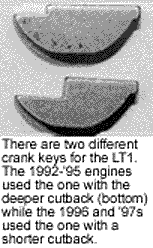
Use the correct key for the year of the
engine. Don’t try to get by with a regular 350 key; the hub will hit
it before it bottoms on the crank gear and it will cause the balancer
and belts to be misaligned.
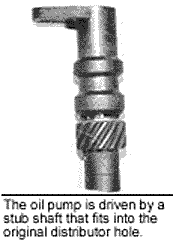
DISTRIBUTOR SHAFT
The drive shaft for the early style distributor is reversible
by design, but it may have a machined lead on it that will cause it to
pump oil past the front cover seal if it is installed backward.
Unfortunately, the shop installs it, so all you can do is wait for the
phone call when the seal leaks and they’re looking for someone to
blame.
CRANK KEYS
There is no keyway in the hub for the harmonic balancer, so
GM used a special cutback key that was flush with the front of the
timing gear on the 1992-’95 engines. It’s p/n 10128303.
When the crank position sensor was added in
1996 for OBD II, the cutback area on the key was shortened so it stuck
out far enough (about 0.100") beyond the face of the timing gear to
index the notched disc that was used for the crank position sensor.
EXTERNAL COOLANT LINES
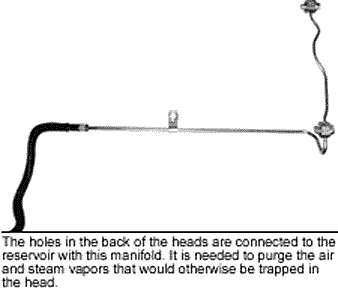
There is an extra hole that goes into the water jacket on
both ends of the heads. These should be plugged when they’re in the
front, but left open when they’re on the back. There’ s an external
coolant transfer line that connects the holes on the back side to a
reservoir that vents the air and steam vapors that would be trapped in
the head and cause hot spots.
FRONT TAPPET CUP PLUGS
Both of the cup plugs in the front of the lifter galleries
have a 0.030" hole drilled in them. These prevent air pockets from
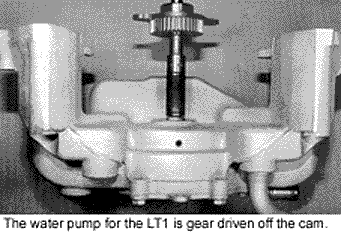
forming in the front of the galleries and provide added lubrication to
the water pump gear drive.
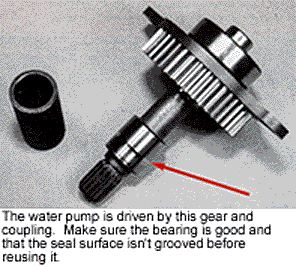
WATER PUMP DRIVE SHAFT
Be sure to check the seal surface on the geared shaft that drives the
water pump. If it’s grooved, it will leak and it will be your fault.
New ones are available from GM (p/n 10219554) for around $40. That’s
cheap insurance when you consider that the timing cover, chain and
gears have to come off to replace it.
OIL PUMP
The LT1 powerplant uses the late model 350 oil pump with the
3/4" pickup tube. This should be fairly easy to identify.
HUB AND BALANCER
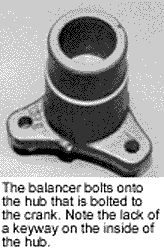
The balancer is a two-piece assembly with a pulley that bolts onto the
hub. Separating the two made it easier to install the Optispark
distributor on the assembly line and out in the field. The holes in
the hub are offset, so the balancer only fits on it one way, but
there’s no keyway in the hub to index the hub on the crank. This
shouldn’t be a problem unless the damper was drilled at the factory to
"trim" the final engine assembly.
If it was drilled a lot to compensate for an
engine that was out of balance, you could end up with a shaker,
depending on how everything stacked up with the remanufactured engine
compared to the original engine. If you encounter a balance problem on
a remanufactured LT1, try rotating the balancer assembly on the crank
90° at a time to see if it eliminates the problem.
THE LT4 CHEVY
There is one more version of the LT1 out there that could cause some
confusion if you get a core and don’t know what it is. The LT4 was the
high performance version of the LT1 that was standard in the 1996
Corvette "Grand Sport" and optional for any 1996 Corvette with a
manual transmission. There were also 100 1997 SS Camaros built by SLP
that came with the LT4. Chances are most rebuilders will never see
one, but just in case you do, the following are a few things that make
the LT4 special.
BLOCK - Should be the same
LT1 casting with the four bolt mains.
CRANK - The LT4 has a
special nodular iron crank with undercut and rolled fillets for added
strength.
RODS - Powdered metal rods
are used with a "cracked cap" instead of a machined parting line.
CAM - The LT4 cam was
similar to the ones used in the high performance LT1, but it has had
considerably more lift at the valve because it had 1.6 to 1 rockers.
HEADS - The heads had
smaller 54cc chambers that gave the LT4 a 10.8 to 1 compression ratio.
The intake ports were raised 0.100", too. The LT4 used larger intake
and exhaust valves (2.00" x 1.55" ). The intake stems were hollow to
reduce weight and the exhaust stem was sodium-filled to improve heat
transfer. The valve springs were made of oval wire to prevent coil
bind with the higher valve lift and fitted with lightweight retainers
to help the engine rev to its 6,300 rpm redline.
All of these changes enabled the LT4 to make
330 hp at 5,800 rpm instead of 300 hp at 5,000 rpm.
That’s about all you need to know about the
LT1 family. They’re out there and they’re old enough to show up on
your dock. Although the LT1 isn’t just another Chevy 350, it’s pretty
straightforward when you know what to expect.
Doug Anderson is vice president of Grooms
Engines, Parts, Machining, Inc., located in Nashville, TN. He has
authored numerous technical articles on engine rebuilding for
Automotive Rebuilder for more than 12 years. Anderson also writes
Automotive Rebuilder’s regular Shop Solutions column.




|